|
Malcom McLean:
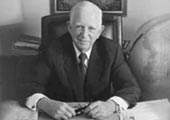
Started his professional career with great impetus and faith in the personal effort and without a great academic training: he only completed secondary school. With the savings he obtained working in a gasoline station, he purchased his first second hand truck which cost him 120 $, he started his transport company in Winston-Salem, South Carolina, devoted to the tobacco shipment in 1934, during the great depression.
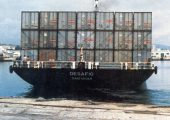
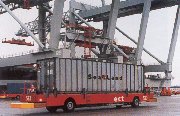
He conceived the idea about containers a day in Hoboken, New Jersey, seating in one of the docks waiting for his truck to be loaded on board. McLean had the idea that the trailer colud be loaded and unloaded saving a considerable time and money , but he could not carry out his dream, because the Inter-State Commerce Commission did not allow road traffic forwarders in that period to be propietors of shipping companies. This circumstance obligued McLean to sell his truck business and after several buying and selling operations of shipping companies he bought the stock of Waterman Steamship Corporation in 1955. Now it was only left to materialise his dream. He adapted two tankers used in Second World War and designed some rectangular boxes to be transported in vessels holds and decks. He had to design also the truck trailers to adapt them to containers. In fact the idea was not new since the lines with rail-maritime connections had already experienced this transport system in 1929 between New York and Cuba to compete with the trucking companies.
Ideal-X:
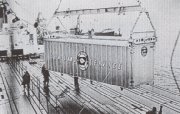
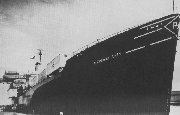
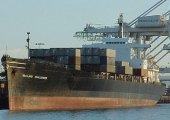
It was in April 1956, when one of the rebuilt tankers, the SS Ideal-X was stowed at the port of Newark, New Jersey, with 58 containers of 35 feet with destination to Houston, Texas. The historic trip was made with the assistance of hundred of businessmen and politician attendance. Freddy Fields, a high executive of the International Association of Stevedores did not share the happiness, and he was asked his opinion on the new transport system, he answered "let's hope that the son of a b... would sink". The anger of Fields was fully justified: the stowage was paid at that time to 5,8$ per ton; with the container arrival, the rate had been reduced to 16 cents per ton, or thirty six time less.
The container transport was gradually consolidating, they had to wait for the adaptation rhythm of ports to purchase the machinery capable to lift containers and also to the passivity oan other difficulties put by the stevedores for whom the container was a true competition.
It was not until the 60's and the involvement of the United States in Viet Nam when the container reached its peak. Sea-Land, the shipping company of McLean was the main supplier of services for the United States Government, till the end of the war. In few years the company nearly had 27.000 containers, 30 vessels and 30 ports of call with the new transport system.
The visionary inventor of container foresaw alsothe importance of containers standarization and homologizing of to be of essential interest for the development of the transport industry in general. Hence the idea arose of the two sizes that we know nowadays: 20' and 40' containers.
Competition worsened and Sea-Land needed capital, therefore he resorted to the old tobacco company that helped McLean in his initial stage as truck driver. U.S. Reynolds Tobacco Co. purchased his shares by 530 million dollars in 1969, holding interests and a position on the Board. The econimic avatars made the Reynolds conglomerate to go through a sharp trend of economic ups and downs, until in 1977 McLean left the company whose capital share was finally sold to Maersk in 1999 changing its name to Maersk SeaLand wich finally adopted the name Maersk Line in 2006. But still there were records for McLean to break; it was in 1978 when he purchased the United States Lines for which he constructed a container vessel with capacity of 4.400 units (teu) the largest that time. Unfortunately, the line went bankrupted in 1978 owing to the high cost of fuel and great inefficiency of vessels consumption.
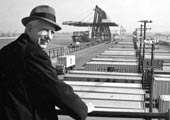
The achievements of Malcolm McLean have decisively contributed to improve the productivity of ports and vessels, which has resulted in lowering the import costs of all products. It has also contributed to end with the hegemony of the New York and London ports ant to expand others, for example, Oakland (California) or Tanjung Palepas (Malaysia). This sustained low cost situation in maritime transport makes that manufacturing industries can be established far from the main consumption centres, contributing to globalisation. In fact, the container makes possible the establishment of a wide centre of development allaroun Asia making it the great variety of competitive products to the Western World.
In 2001, McLean died in his house of Manhattan when he was 87 years old. It has been recognised as one of the men who contributed most to the maritime trade development, or, "as one of the revolutionary men of the maritime industry of the XX Century" according to Norman Y.Mineta, US Transport Secretary.
(Portnewspaper)
1956-1996:
1956 Ocean-´borne containerization is introduced with the shipment of a Sea-land container aboard the Ideal- from port Newark, N.J., to Houston, Tex.
1957 The first full-celled container ship, the sea-land Gateway City, begins regular service between New York, Florida and Texas.
1958 Sea-Land introduces offshore container ship service to Puerto Rico, with the loading of the SS Fairland in San Juan.
1962 New Jersey Governor Richard Hughes dedicates the Port Authority of New York and New Jersey seaport in Elizabeth, N.J. Today, Sea-Land's 232-acre facility in Elizabeth is the world's largest privately operated container terminal.
1963 Sea-Land begins the first intercoastal service between the East and est Coas of the United States.
1964 The SS Anchorage breaks through the ice-clogged Cook Inlet, bringing the first regular, dependable year-round service to the port of Anchorage.
1966 Sea-Land launches trans-Atlantic service, and soon the gray containers with the bright red logo are a familiar sight in the great cities of Europe. Sea-Land begins military support service to Subic Bay in the Philippines and Okinawa.
1967 Sea-Land sets up container port facilities at Saigon, Cam Rahn Bay, Da Nang and Que Nhon. With seven ships dedicated to Vietnam service, Sea-land is able to carry 10 per cent of the supplies destined for Vietnam. The remaining 90 per cent required the service of more then 250 other ships. Sea-Land's effort proved the effectiveness of container shipping for militay support in a war zone.
1968 Sea-Land launches the first commercial, fully containerized service between japan and the United States. One of the first offices was set up in Yokohama.
1969 The company expnds its container ship network to ports in Hong Kong, Taiwan, Jamaica, Portsmouth, Va., and five more European ports. canada becomes part of Sea-land's network, with offices in Vancouver. We open offices in Montreal and Toronto in 1976. Sea-Land orders eight SL-7 class vessels. The largest and fastest container ships in the world, capable of reaching 33 knots.
1970 Sea-Land expands into five Mediterranean ports, with weekly sailings to cadiz and Barcelona; Marseilles and Genoa; and Naples. The company also begins service to Korea.
1971 Sea-Land places two new SL-18 class container ships in North Atlantic service.
1972 Sea-Land introduces a new "land bridge" service, spanning the continental United States. The service provides transit between the West Coast and Europe and between the East Coast and Far East.
1973 Sea-Land introduces a new liquid bulk tank, with a pressure rating 10 times than of older tank containers. Certified by teh U.S. govenrment to carry more than 400 liquid commodities, these tanks were developed primarily for the rum and whiskey trades. Sea-Land opens its new container in Elizabeth, New Jersey.
1974 Direct linehaul service begins to the Dominican Republic.
1975 Sea-Land opens a container terminal at Algeciras, Spain. The terminal becomes the major link between the Mediterranean, Middle East and European services.
1978 Sea-Land establishes a private, limited corporation responsible to the Ruler of Dubai for the design, operation and manteinance of a state-of-the-art, 66-berth, deepwater port and trucking operations at Mina Jebel Ali, United Arab Emirates. This is the largest port complex in the Middle East. With its expanding network, Sea-Land is able to move containers around the globe.
1979 Container ship service to India begins, with bi-weekly sailings between Dubai, United Arab Emirates, and Bombay and Cochin. The Sea-Land Patriot, the first of the 12 new D-9 class diesel container ships, is launched at Kobe, Japan. This represents the largest vessel construction program undertaken by a private carrier. By October 1980, all 12 D-9 vessels are operating in the Sea-Land fleet.
1980 Sea-Land begins the first regularly scheduled container ship service between Shanghai, Peoples's Republic of China, and North America.
1982 President Reagan waves to onlookers after signing the Export Trading Act of 1982 in Long Beach, Calif.
1983 Sea-Land begins the first regularly scheduled service to Port of Halifax, Nova Scotia, by a U.S. carrier.
1984 Sea-Land Corporation emerges from R.J.Reynolds Industries, Inc., as an independent, publicly held company , with stock trading on the New York Stock Exchange. The company achieves the highest revenues and earnings in its 28-year history. A $ 180 million contract is awarded to a U.S. shipyard for construction of threee fuel-efficient, diessel-powered D-7 class ships.
1985 Sea-Land's new terminal at Tacoma features rail-on-dock service.
1986 CSX Corporation buys Sea-Land. The move allows CSX, based in Richmond , Va., to combine rail, sea and overland cargo movement.
1987 Sea-Land forms Transport Logistics Service to provide expanded truck, rail and barge service within Europe. (Renamed SeaLand IntraEurope in 1991)
1989 Sea-Land invests more than $ 150 million in refrigerated cargo equipment and services. The reefer fleet total more than 14,000 containers. Expansion of the Kwai Chung container freight station in Hong Kong makes it the largest industrial building in the world.
1990 Sea-Land announces agreements to pioneer containerization in the Former Soviet Union; the agreements include development of the trans-Siberian land bridge. Sea-Land begins servivce to Saudi Arabia in support of U.S. troops in operation Desert Storm.
1991 The Pacific Division announces a VSA with Maersk Line in the trade between North America and Asia. John P.Clancey is named president and chief executive officer after Alex Mandl joins AT&T as chief financial officer.
1993 The automated Delta Terminal in Rotterdam begins operation.
1994 Sea-Land announces the consolidation of its headquarters and other management operations in Charlotte, N.C. The move, in 1995, places operations from Liberty Corner, N.J., Seattle, Wash., and Rotterdam, The Netherlands, at the new location.
1995 The Tactical Planning Center in Charlotte, N.C. offers a global perspective of the Sea-Land network. Sea-Land and Maersk announce plans for an operating alliance to provide customers with an unmatched level of comprehensive service to most major port ranges in the world.
1996 Sea-Land celebrates 40 Years Of Transportation Creativity.
(Insight special issue 1996)
The 1992 strategic plan:
Was conceived and approved by Sea-Lands's Senior Management Committee in the summer of 1991. The plan is customer focused, designed to meet emerging market requirements. It has been endorsed by our parent company, CSX Corporation. All those involved in its development recognize fully that it is a challenging plan, and that successful implementation calls for a concerted effort by all associates, working cohesively on several fronts simultaneously.
Underlying the plan is the key concept of balance. It is neither a so-called "growth" plan nor a "productivity" plan -it envelops both objetives. The plan also addresses both our stregths and weaknesses as a company. The initiatives in the plan are designed to leverage the former and overcome the latter. We realize tha while Sea-Land will be proceeding on many fronts -taking growth initiatives and applying productivity measures, working on our stregths as well as weaknesses- emphasis will shift in the line with near-term economic and business conditions and market forces which influence our ability to achieve near-term financial goals. In other words, within the framework of the plan, management will priorize and continually reassess the priority of initiatives taken to assure that owner and investor requirements are realized. Simply put, the scales will shift periodically but balance, ultimately, will result.
The strategic plan is driven by the Sea-Land Mission and will be implemented by associates embodying Sea-Land Values. Both our mission and value statements are placed prominently in the plan document and, jointly, succintly define Sea-Land´s purpose as a company, the constituencies that we serve -our customers, investors and associates- and our behavioral and ethical standards. The Sea-Land Mission Statement and Sea-Land Values Statement are consistent in principle with stetements adopted by CSX Corporation and its other operating units.
The plan tells us, "what we have to do as a company to succeed." A careful reading will reveal we must retool in several areas to deliver the level of service required by customers. Inherent in the plan is a recognition that while Sea-Land has been making impressive strides, global competitors have learned from us, are adopting a more sophisticated approach to the business and many, clearly, benefit from greater access to capital and more favorable cost structure. Furthermore, the plan acknowledges that the trend of Sea-Land's costs are a serious problem and that rate offsets are not compesatory. In this important respect, the strategic plan is a, "call to action" for all of us.
Sea-Land has enjoyed considerable success in recent years and our gains have been recognized by our customers, owners, investors and industry observers. This is a platform we can build upon to fulfill our future goals and ensure rewarding careers. The plan is only a guide -your efforts will define our progress.
Productivity:
An absolute requirement of plan success. Implementing productivity/cost effectiveness initiatives will enable Sea-Land to keep its rates competitive and provide the margin improvements needed to achieve an ROIC in excess of our cost of capital. We are challenged to implement a reduced cost structure and, simultaneously, improve the quality and customer focus of our service offering.
Process analysis and improvement is the primary tool used for achieving long-term, systemic productivity/cost effectiveness gains. By examining and evaluating how we do our work, by developing and implementing new and refined processes for accomplishing our work, costs will be reduced and margins will increase. The newly-formed Operations Council will lead this effort, and all line and support functions have an obligation to improve work processes by applying the four quality principles.
Customer Focus:
Sea-Land remains committed to tailoring our service offerings to meet customer requirements. All of the thrusts and specific initiatives in the plan are consistent with this approach. The CFI process which is in place worldwide provides a framework for evaluation, setting standards and benchmarking so that continous improvement meeting customers's requirements results. The customer-focused Basic Transportation Service components of transit time, reliability, documentation, equipement and customer service -familiar to all of us- remain the foundation of our strategy. Sustained focus on improving BTS quality will produce the balance of operating expense savings and increased business to reach our goals. Accordingly, BTS will be given the highest priority in allocation campany resources.
Infrastructure Development:
Primary focus on the base infrastructure -information systems, the global organization (our team capabilities), and our terminal network- maximizes Sea-Land's potential for building competitive advantage. Plan initiatives are designed to leverage, or move effectively employ, these major strengths.
Expansión:
We will grow, or expand, our coverage of world markets. In addition, we will continue to add service capabilities which bring our Strategic Vision as a global distribution company closer to reality. Geographic and service expansion will be orderly and carefully targeted to enhace achievement of financial goals.
Strategic Vision:
This projects our gradual transformation from an ocean carrier to, ultimately, a global distribution company and cites key steps in that passage across a time line. The company's Strategic Vision is consistent with our mission. Application and the commitment to adhere to Sea-Land Values will foster the culture required to achieve plan goals and will provide for enriching careers.
Sea-Land Values:
The primary responsibility of every Sea-Land employee is to serve customers is the spirit of partnership in order to understand and satisfy their needs. We must provide quality execution on a consistent basis over the long term through:
- An organization that values its employees and respects their dignity.
- A commitment to teamwork, openess and candor.
- A commitment to increased quality and continous improvement.
- Increased empowerment and personal accountability.
- A commitment to ethical conduct.
- A willingness to innovate and change in well-planned ways that yield a competitive advantage.
- A sense of urgency and bias for action.
Only by carrying out these values will Sea-Land be able to fulfill our ultimate responsibility to provide sustainable, superior returns to our shareholders.
Sea-Land Mission:
Sea-Land is global distribution company. We will lead our industry in providing high quality, intermodal containerized transportation and innovative logistics services.
We area team that competes to win, adhering to high ethical standards and regulatory guidelines. We are dedicated to growing profitably and improving our company continuosly, throuh the excellence of our people, focus on our customers, and by leveraging the strengths of our organization, our technology, and our physical assets.
We are commited to being the best in our industry in fully meeting the needs of our three major constituencies:
- For our customers, we will work as a partner to provide excellent service by meeting all agreed-upon commitments.
- For our employees, we will create a work enviroment that motivates and allows them to grow and develop and perform their jobs to the maximun of their capacity.
- For our shareholders, we will meet our goals to provide them with sustainable superior returns.
South East of Asia (2006):
The current structure of commercial exchanges, placing China and the rest of countries of the South East of Asia as the origin of goods distributed round the world, true engine of world trade, this has meant a non stop increase of port traffic of the mentioned area (in the 1st TOP 100). There are 11 Chiese ports handling over 73 million teu, which means the 25% of those handled by the first hundred world ports). And also an unbalance between the traffic of full and empty containers which has been slown down by the need of raw materials from China, all this means the development of logistics planning to a large scale.
|